Designing for AI Agents in Signals
Redesigned advertiser-facing notifications and issue resolution for an AI-first workflow, writing content that works for both non-technical marketers and the AI agents resolving their problems.
The problem
Advertisers depend on integrations like the Conversions API and Meta Pixel for accurate ad data. When those integrations break, targeting and reporting suffer.
The structural challenge: the people who see the warnings are marketers. The people who can fix them are developers.
- Marketers don't have the technical background to act on the issue directly
- Developers don't have access to the UI where notifications appear
My job was to turn marketers into effective messengers of technical information: simple enough to understand, precise enough for a developer to act on.
My role
Lead content designer on two related GenAI initiatives tackling this problem. Also owned rollout strategy and alignment across content design and engineering partners on surfaces outside Events Manager.
Send to Agent
Developers were increasingly using AI coding agents like Cursor or Copilot. If issue resolutions became prompts instead of guides, developers could hand them straight to an agent.
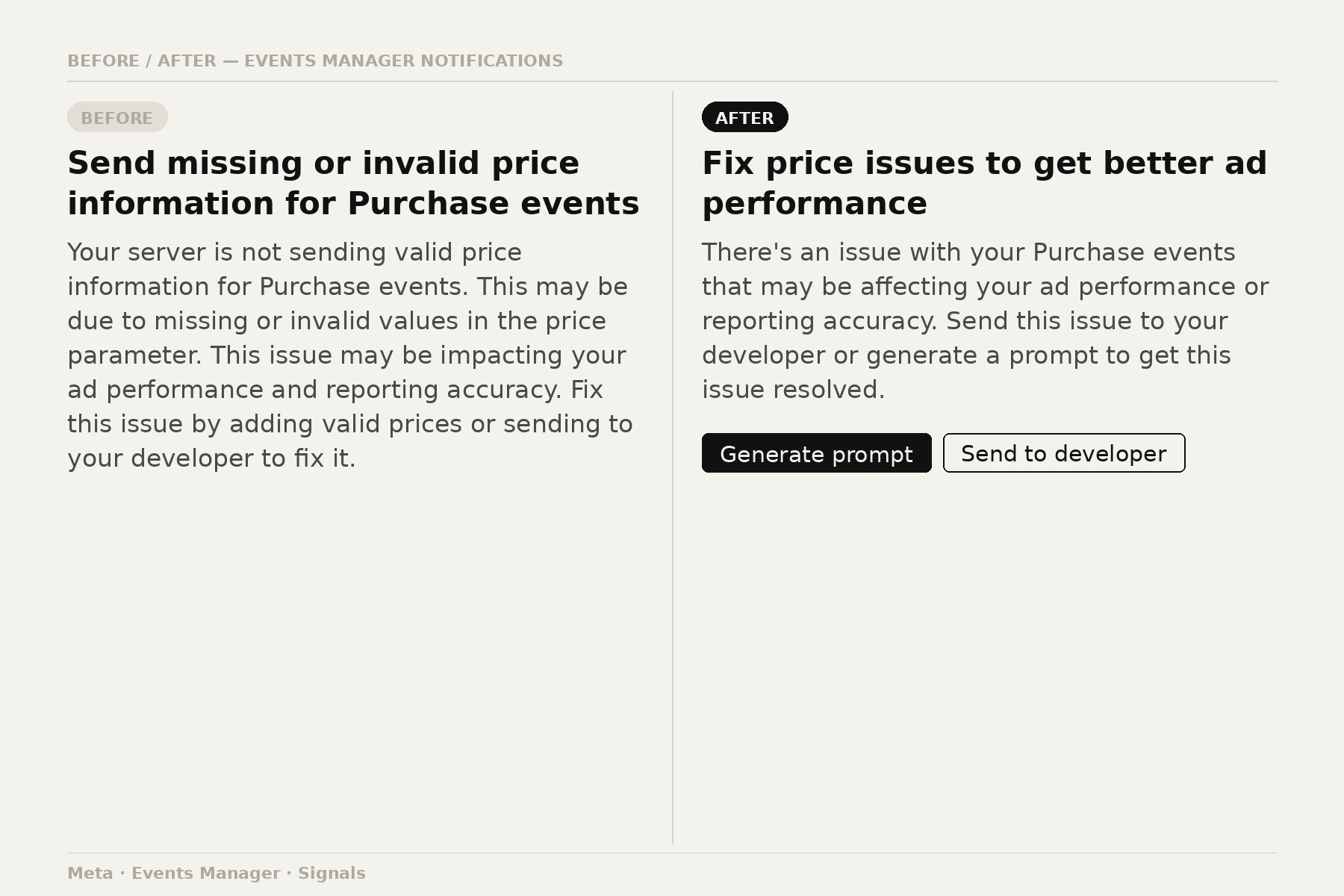
That changed what the notification itself needed to do:
Before
Send missing or invalid price information for Purchase events
Your server is not sending valid price information for Purchase events. This may be due to missing or invalid values in the price parameter. This issue may be impacting your ad performance and reporting accuracy. Fix this issue by adding valid prices or sending to your developer to fix it.
After
Fix price issues to get better ad performance
There's an issue with your Purchase events that may be affecting your ad performance or reporting accuracy. Send this issue to your developer or generate a prompt to get this issue resolved.
The notification became a business-impact statement with a clear action. Technical detail moved into the prompt, where it was actually needed.
"The complexity doesn't go away. It moves upstream, into how you design the prompts and logic the agents act on."
Writing the prompts required a different discipline than writing for humans:
- Unambiguous and structured for machine parsing
- Complete enough for the agent to act without extra context
- Clear placeholders for advertiser-specific details we couldn't know in advance
- Built-in micro-messaging prompting users to review before running anything
Designed and handed off to engineering before I left Meta.
Bundled issues
A related problem: marketers facing multiple integration issues had to send separate emails for each one. My hypothesis: GenAI could group related issues into a single communication without losing anything important.
Guiding principle: any solution had to deliver equally good outcomes for the advertiser, with less effort.
To build the business case, I pulled our full library of diagnostic messages into a spreadsheet and used Claude to generate and pressure-test grouping frameworks by dataset, event type, and performance impact, weighing which groupings would make sense to a marketer versus a developer, and where GenAI could group confidently versus where it would just create confusion.
Early-stage work. About a week into risk and constraint discovery with a designer and engineer when I was laid off, aiming for H2 2026 prioritization.
Where things stand
Both projects were in progress at the time of the Meta layoffs. Send to Agent was further along, in engineering handoff. Bundling was still in business case and discovery.
The core insight behind both: as AI agents enter the advertiser workflow, content design's job shifts from technical translation toward articulating business impact clearly. The complexity doesn't disappear. It just moves upstream.